by Heidi Riley
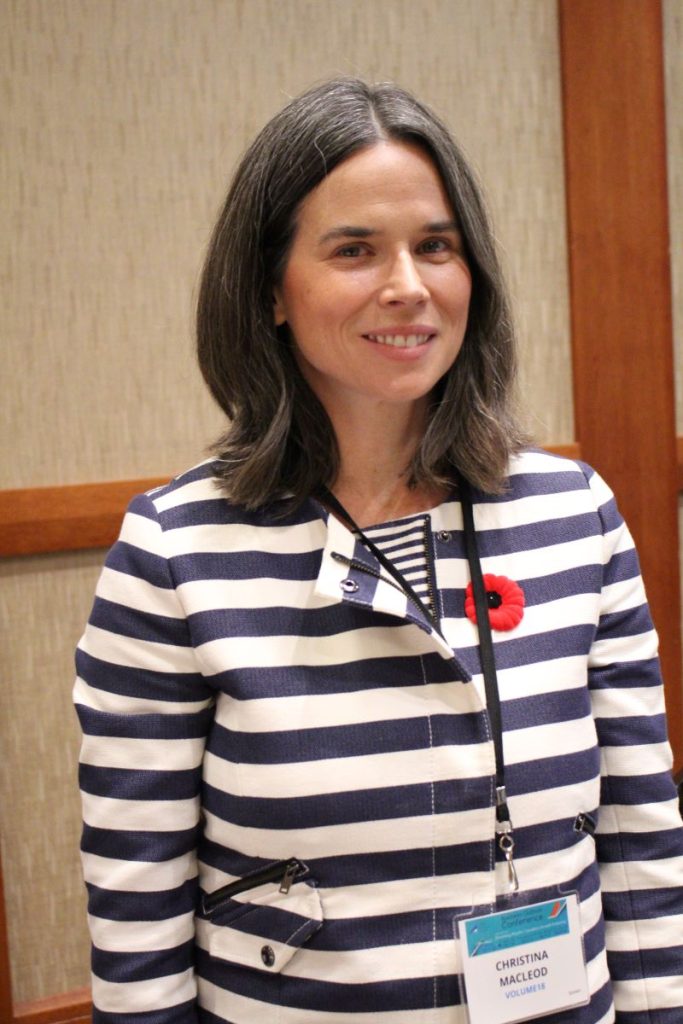
At the Atlantic Economic Council conference, held in Charlottetown in November, Christina MacLeod, Partner, VOLUME18, shared insights and strategies on how her company is driving growth through productivity improvements within the organizations she works with. The panel discussion focused on questions from the audience that addressed technology, AI, population changes, and the road to net zero.
VOLUME18 is a public relations and strategic communications firm based in Stratford, PEI. The company, which is in its seventh year, works with private businesses, industry associations, non-profits, academic institutions, and government on strategies and communications.
“My background, which is in policy and public programs, is paired with communications and marketing,” says Christina. “We help organizations that have communications issues to determine their goals and find a way to work together more effectively. We also do consultations with stakeholder groups and communities to find improvements and look at innovative practices in the region and nationally.
“We are looking at the current productivity lag on PEI and nationally, and wondering what innovations and technology we can embrace, what type of labour force and skills we will need for the new economy, and what changes are necessary to sustain economic growth and change the narrative.”
How does your organization adapt to change?
“Change is inevitable. Laying the groundwork is really important for internal and external stakeholders when bringing in new technologies. One client I worked with was bringing in new technology that would shift the labour force. We had conversations about how that change would be a positive that would grow the company and the community, be more sustainable, use less inputs, and have less impact on the environment.
“We need to change the conversation early so that we don’t get that resistance to change, which is sometimes our first reaction. Also, being forced to make rapid change is not sustainable.
“We also need to look at internal processes. We need to encourage a ‘can do’ mentality and communicate and reach out to people to implement that change. We must look for that next innovation and new piece of technology to constantly bring us forward rather than continuing as we were.
“We need to look at the new generation coming into the workforce – what skills they have, and where they see shifts in processes. We like to de-risk everything, but we need to have more of that excitement and opportunity to try something new. There is no perfect solution – sometimes we need to try things and see how the markets will shift.”
How will the effort to achieve net zero transform businesses across Atlantic Canada?
“I earned my Master’s degree in New Zealand, which has long been a test case for new technology,” says Christina. “That is what the Cleantech Academy in Georgetown is looking to do. To encourage and innovate and support the effort to get to net zero, we need to encourage and support companies and industries to take the risk.”
Christina says that making changes towards a low-carbon economy will come with a lot of opportunities. “We need to look at our inputs and our energy use and make sure we are being as efficient as possible. The competitive edge achieved by accepting the research and new technology will make our industries more efficient and competitive. Those changes make economic and business sense – using renewables and reducing inputs used for energy and other needs will reduce our reliance on energy imports and will stabilize our industries.
“We need to surround our industries with great researchers, and we need to get the technology here. We need to offer support for implementing the technology and show, case by case, how things can be done more effectively and efficiently. When companies spend millions of dollars every year to produce a product, they will not risk a change unless they know that the result will be the same or better. Instead of looking at the effort to reach net zero as giving up something, they have to look at it as becoming more efficient and attractive.”
How can companies respond to a decreasing labour force?
Christina pointed to PEI’s post-secondary institutions which partner with industries to offer courses on updating skills. “When AI or any new process comes in, people worry about losing jobs. But it is an opportunity. We need to be flexible and shift the culture.
“Those already in the workforce need to be given the opportunity to upskill to cope with shifts in the workplace. We need to look at the immigrant population already settled on PEI and find out what skills they hold that we could be capitalizing on, get them into our industries, and make sure they are working at the level they should be.
“As the population ages, we need to re-skill and up-skill people over 65 and encourage them to stay in the workforce.
“To get people to move to PEI and join industries here, having reliable rural internet service is extremely important. We need to make sure that basic infrastructure is in place.
“We also need to narrow the productivity gap. As our population stops growing, investment in technology is one solution to a lack of access to a low-skilled workforce.”
FOR MORE INFORMATION
about VOLUME18, visit https://volume18.ca